

An American Psycho’s Guide to Business Card Design

In the 2000 film American Psycho, Christian Bale plays investment banker Patrick Bateman with unnerving calm and obsessive precision. In one of the film’s most recognizable scenes, Bateman and a group of executives sit around a conference table comparing business cards as if tiny design differences determine survival. A slightly heavier font weight and a brighter shade of white paper trigger visible insecurity among grown men in tailored suits. The tension rises over paper stock and typography while no one discusses revenue, alignment, or customer response. The scene exposes how easily professionals confuse refinement with effectiveness.
The executives in that room are not evaluating whether the card generates business or clarifies a service. They are performing status theatre inside a controlled environment. The card becomes a symbol of dominance rather than a tool of communication. The horror in that moment is not violence but misplaced priority. Surface detail replaces structural function. When marketing becomes ego competition, performance disappears quietly in the background.
If your business card only impresses competitors, it is already failing in the real world. A card exists to generate response outside the boardroom, not admiration within it. Clarity, relevance, and placement determine whether it works. Without those elements, it becomes decorative paper with no measurable impact. Strategic design replaces vanity with sequence.
Years ago, I printed a small batch of business cards and left several at a local hamburger stand where customers waited for their orders. The design was simple and direct, with a clear service description and a small graphic of a man holding a video camera. One of those cards led to a two-thousand-dollar DVD production project and an opportunity to work alongside a grey-haired broadcasting veteran with experience at the ABC television network and Armed Forces Network (AFN). The return did not come from specialty finishes or premium stock. It came from clarity and placement.
The broadcasting veteran understood production immediately because the camera graphic signaled relevance within seconds. There was no confusion about what I offered and no need for extended explanation. The design aligned with his professional identity in a brief moment of recognition. That alignment created movement without persuasion. The card worked because it reduced friction.
There is a psychological principle called cognitive fluency, which refers to the brain’s preference for information that is easy to process. According to research published in Personality and Social Psychology Review, people evaluate information more favorably when it requires less mental effort to interpret. When a message is clear, trust increases and hesitation decreases. Clear hierarchy reduces friction, and reduced friction increases response. Strategic design respects that reality.
Design Is Not Decoration. It Is Controlled Sequence.
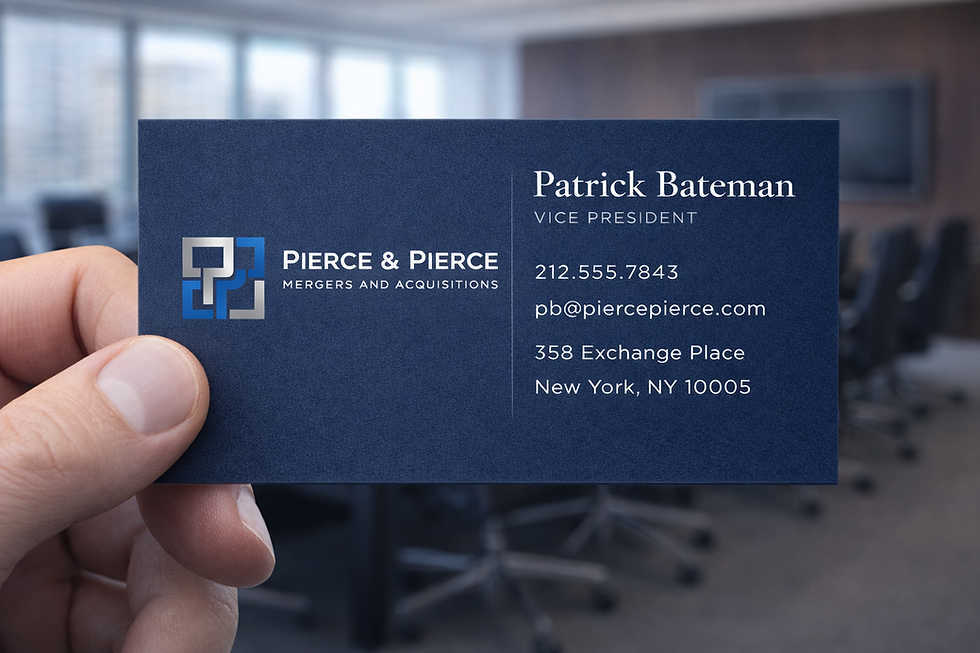
Design is not decoration and it is not an exercise in taste. It is controlled sequence that guides attention toward relevance in a predictable order. Every element must justify its presence within that sequence. When elements compete, clarity collapses and attention scatters. When hierarchy is intentional, understanding happens quickly and naturally.
Photography Must Signal Identity, Not Ego
A photograph on a business card must communicate professional context rather than vanity. A contractor standing beside completed work signals capability. A real estate agent photographed inside a staged interior signals market alignment. A glamour portrait without context signals nothing about service. If the image does not reinforce what you do, it weakens hierarchy.
Casual selfies and poorly lit mug-style photos often reduce credibility rather than enhance it. The card is not social media; it is compressed communication. Appearance may attract brief attention, but relevance attracts qualified response. Sustainable marketing aligns with service identity rather than physical attributes. In many cases, omitting photography entirely strengthens authority and clarity.
Logos Must Support Recognition and Authority
A logo signals legitimacy and continuity over time, and it should always appear on professional materials. However, recognition does not require dominance. A national brand such as McDonald’s relies on the golden arches because brand equity is its primary asset. Most local businesses rely on service clarity first. The logo should support recognition while preserving hierarchy.
If the logo overwhelms the card while the service description remains vague, the design fails. Recognition follows relevance rather than replacing it. Authority emerges from structured communication. Size alone does not create credibility.
Color Must Reinforce Brand and Print Accurately
Because business cards are printed assets, color must be evaluated in CMYK rather than RGB. CMYK is the ink-based system used in commercial printing, while RGB is optimized for screens and digital design. Many digital design tools, including Canva, default to RGB because they are built for screen presentation. When RGB files are exported for print without reviewing CMYK values, color shifts often occur.
A blue that appears vibrant on a laptop may print darker in ink. A light gray may fade against white stock. A bright yellow may flatten once translated into ink percentages. This does not indicate a flawed tool; it reflects the difference between light and pigment. Reviewing CMYK values before production protects brand consistency.
Consistency across mediums still matters. If your website uses deep navy (RGB 10, 61, 98), your printed materials should approximate that tone intentionally in CMYK percentages. Contrast determines legibility under real lighting conditions. When contrast fails, readability fails, and response decreases accordingly.
QR Codes Must Be Designed With Purpose
A QR code is not an afterthought that fills empty space. It is a structural element that must sit intentionally within hierarchy. If the code is oversized, it competes with the relevance signal. If it is too small, it becomes unreliable to scan. Proper scale preserves both balance and function.
Placement must follow sequence so that the viewer understands who you are and what you do before encountering the code. Clear labeling reduces hesitation by explaining what happens after scanning. Black ink (CMYK 0, 0, 0, 100) on white stock produces the most reliable scan performance in print environments. Decorative gradients may weaken contrast and reduce reliability.
The strategic value of a QR code extends beyond convenience. It creates attribution.
If a business card lists only a website URL, any later visit blends into general traffic. You cannot determine whether the visitor typed the address manually, found it through search, or arrived from referral. When a QR code directs to a dedicated landing page built specifically for business card distribution, the traffic becomes identifiable. You can measure how many people scanned the code, what device they used, how long they stayed, and whether they completed a contact form.
This level of tracking changes how you evaluate distribution strategy. If you leave cards at a networking event and see a spike in scans within forty-eight hours, you have data supporting effectiveness. If cards placed in a specific location produce no scans, you have feedback without guessing. QR integration turns a static card into a measurable channel.
The reduction of friction also matters. Typing a website requires effort and introduces opportunity for error. Scanning reduces steps between curiosity and action. When friction decreases, completion probability increases. A properly structured QR code does not modernize the card for appearance. It strengthens the card’s role within a working system.
Shape and Stock Must Balance Distinction and Retention
Unusual shapes and premium materials can increase initial noticeability, but practicality determines retention. Non-standard sizes often fail to fit wallets or holders. Heavy stocks increase cost and reduce quantity. Distinction only matters if usability remains intact.
Novelty materials such as seed paper or specialty fiber paper can serve as conversation starters when aligned with brand identity. A sustainable business may reinforce positioning through plantable paper. A creative professional may experiment with transparent plastic that reflects industry craft. Novelty without alignment weakens credibility, but novelty with relevance strengthens memorability.
The Back of the Card Should Reflect What You Do
The backside of a business card should extend identity rather than duplicate information. A hardware store could include a small measurement conversion chart to reinforce precision. A farmer’s market vendor who sells eggs could include a simple bread recipe to increase kitchen utility. An estate planning attorney could provide a concise checklist of essential documents to encourage reflection. A funeral home could offer a calm planning outline to support preparedness. A photographer might include lighting notes or a subtle color reference grid.
Each example reflects service identity rather than random creativity. Practical backs strengthen retention, and reflective backs strengthen memory. If backside content feels disconnected from what you do, hierarchy weakens and credibility declines.

Placement Is Strategy, Not Geography
Leaving business cards randomly is not networking; it is littering with hope. Distribution without context assumes exposure equals opportunity. Exposure alone rarely produces alignment. Alignment creates response.
A commercial contractor who builds high-rise structures should not leave cards at a laundromat because the audience does not match the service. A personal injury attorney may align with auto repair shops or physical therapy clinics where liability conversations already exist. An estate planning attorney aligns better with banks and financial advisors where long-term asset decisions occur. Context amplifies relevance.
Research published in the Journal of Marketing demonstrates that advertising performs more effectively when presented in environments aligned with consumer intent. When placement reflects need probability, the card becomes timely rather than intrusive. Volume without alignment wastes effort. Precision produces response.
Identity Without Substance
Patrick Bateman’s character is defined by meticulous surface control that masks structural emptiness. His image is polished, curated, and carefully maintained. Beneath that surface, however, there is no meaningful foundation. The aesthetic is disciplined while the substance is hollow.
Business card design can fall into the same trap. You can perfect stock, weight, and finish while ignoring clarity, alignment, and infrastructure. When surface refinement replaces strategic sequence, performance suffers. A card should not function as costume; it should function as system.
If your business card looks impressive but fails to clarify your role, connect to measurable infrastructure, and align with audience behavior, it is time to rebuild it intentionally. Woodruff Media designs business cards as part of larger marketing systems rather than isolated pieces of paper. If you are ready to move from vanity to structure, contact Woodruff Media and redesign your card with strategy at the forefront.
Written with AI assistance based on the author’s ideas, experience, and editorial direction.


Comments